


In recent years, Volpak’s growth has accelerated, driven by the global success of flexible pouches—a format that fits the modern, fast-moving lifestyle and offers strong sustainability advantages. As demand and production volumes grew, so did the internal movement of parts and subassemblies, putting pressure on both space and workforce. The company faced a clear challenge: how to handle higher logistics complexity while maintaining flexibility, quality, and efficiency within the existing footprint.
From push to pull: a new logistics philosophy
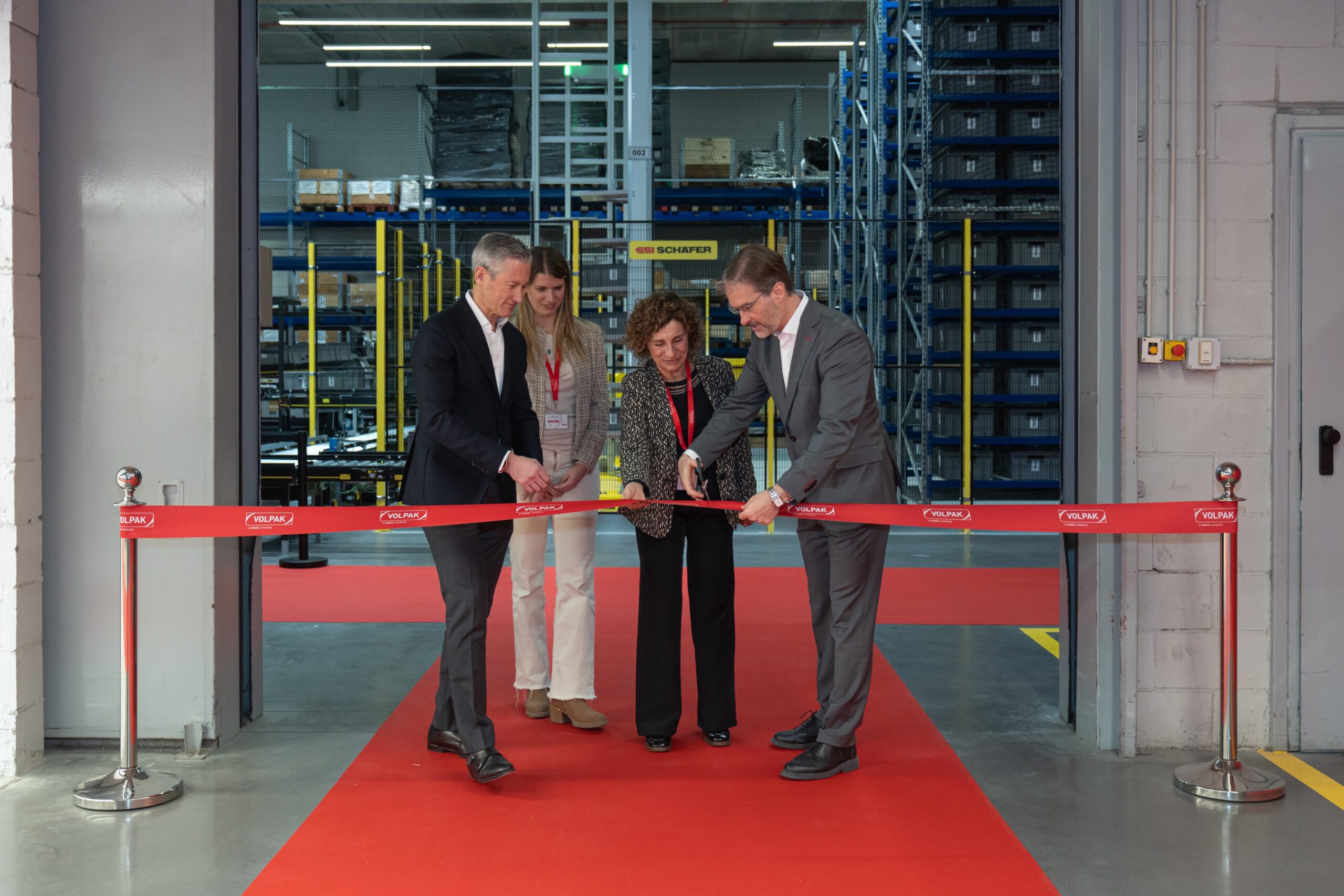
Volpak’s answer was a complete shift from a “push” to a “pull” material-flow model, where every movement responds directly to production demand. The first milestone came two years ago with the introduction of autonomous mobile robots (AMRs) that deliver selected components from the warehouse to the assembly lines. The new phase brings full system integration: a fully automated warehouse synchronized with three AMR connected to the production floor and synchronized with three AMRs, ensuring seamless, just-in-time delivery of materials.
A compact factory, a complex challenge
Volpak’s Barcelona site is spread across two levels—a configuration that naturally limits traditional warehouse expansion. To overcome this, the new system leverages vertical conveyors, high-density storage, and multi-level transport routes, creating a continuous material flow across the plant. The resulting architecture introduces a multi-level material-flow system designed to maximize capacity and minimize travel time. Each component, from inbound goods to production orders, is tracked and routed automatically through intelligent conveyors and buffer zones, linking warehouse, inspection, and assembly areas with precision timing.
Data, segmentation, and efficiency
Before implementation, Volpak performed a complete analysis of its more than 40,000 Stock Keeping Units (SKUs) — unique codes used to identify each part or component stored in the facility, classifying them into A-B-C categories based on frequency and movement. The resulting setup now dedicates high-throughput areas to “A” parts (representing 80% of movements) while lower-demand components are efficiently stored in deep racks. The new automated storage system provides over 50% additional storage capacity and scalability, allowing the company to absorb an expanded SKU portfolio. The integration of autonomous robots that handle boxes directly within the racking system ensures high throughput with minimal footprint.
An ecosystem built for Lean excellence
The project consolidates Volpak’s Lean Transformation path, which has already improved assembly areas and introduced Just-in-Time principles across operations. With the new setup, material preparation follows a “one-piece flow” logic: production orders are assembled and delivered as complete kits, minimizing waiting times and ensuring that every group has exactly the parts needed to start work. The result is a faster, cleaner, and more ergonomic process that reduces handling, improves safety, and enhances operator efficiency.
A benchmark for Coesia’s operational future
Entirely designed and managed by Volpak’s internal teams—with Coesia’s engineering and digital expertise as enabler—the new intralogistics system represents a scalable model that could inspire similar evolutions across the Group. It embodies the convergence of Lean principles, smart automation, and advanced logistics design—proving that even a multi-level, space-constrained facility can achieve world-class operational excellence through intelligent planning and innovation. Looking ahead, Volpak’s new intralogistics architecture strengthens its role within Coesia’s long-term strategy, setting a clear path toward fully connected, Industry 4.0–ready operations and positioning the Barcelona plant as a reference model for future advancements across the Group.